Decepticon
Galvatron
Decepticon Leader, reborn
"Now I will finish what Megatron began!"
An overwhelming force of destructive power whose madness makes him unpredictable to his enemies and lethal to his own subordinates.
FactionDecepticon
Alt-modeParticle-beam cannon
Debut1986 . The Movie
VoiceLeonard Nimoy
WeaponsParticle cannon
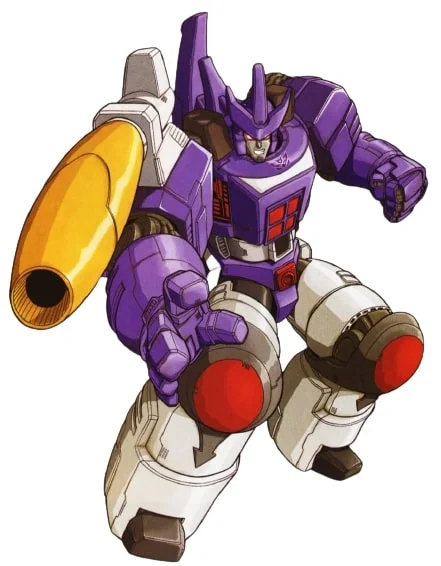
Image via TFWiki (Teletraan I: The Transformers Wiki), used under fan-archive fair use · source
Profile
Galvatron is what Unicron makes of Megatron. Found broken and drifting after Starscream jettisons him from Astrotrain, Megatron accepts a bargain with the planet-eater, is rebuilt into a new body, and returns as something both more powerful and considerably less coherent. His first act is to vaporise Starscream mid-coronation, which is the most efficient statement of intent in the entire franchise, and the first sign that the calculating warlord has been replaced by something closer to weather.
Where Megatron schemed, Galvatron erupts. He is not stupid and he does pursue long-term objectives, but his instincts run through rage, and his own troops are in as much danger as his enemies. Season three builds a surprising amount of story out of this. In "Five Faces of Darkness" he is recovered in a state of raving insanity and restored, imperfectly, in the lava pits of Thrull. In "Webworld", co-written by Wolverine's Len Wein, Cyclonus becomes so desperate that he tricks his own leader into checking into Torkulon, a planet-sized asylum, which exhausts every therapy available and fails. That is a genuinely strange premise for a toy commercial, and it is one of the best-remembered episodes of the show.
His authority is real but constantly undermined by his volatility. Cyclonus's loyalty is the only stable thing in his command, and Starscream's ghost exploits Galvatron's paranoia directly in "Starscream's Ghost". Leonard Nimoy's cold, controlled reading in the movie and Frank Welker's ranting season three performance are almost two different characters, which is itself part of why Galvatron is remembered as unstable.
Abilities and weaknesses
Galvatron's right arm mounts a particle beam cannon of far greater output than Megatron's fusion cannon, capable of destroying a Transformer outright in a single shot, as Starscream discovers. He transforms into a laser cannon and is physically stronger and more durable than his previous form, drawing on power Unicron built into him. Documented weaknesses: he requires recharging from extreme energy sources, and in 'Five Faces of Darkness' has to be restored in the lava pits of Thrull to function at all. His far greater problem is psychological. His madness is treated in-fiction as a genuine tactical liability, costing him plans, troops and alliances, and leaving him vulnerable to manipulation by anyone patient enough to feed his paranoia, including Unicron's residual influence and Starscream's ghost.
Tech specs
Strength
10/10
Intelligence
8/10
Speed
6/10
Endurance
9/10
Rank
10/10
Courage
10/10
Firepower
10/10
Skill
8/10
Key appearances
| Episode | Why it matters |
|---|---|
| Five Faces of Darkness, Part 2 | Establishes the season three status quo: Galvatron found raving on Thrull and restored, incompletely, in its lava pits. |
| Webworld | Cyclonus commits his own leader to Torkulon, a planet-sized asylum, in the series' strangest and most character-driven Galvatron story. |
| Starscream's Ghost | Starscream's spirit possesses Cyclonus specifically to exploit Galvatron's instability and paranoia. |
| The Burden Hardest to Bear | Galvatron pursuing the Matrix, and one of the clearest looks at his long-term ambitions surviving his madness. |
| Call of the Primitives | Galvatron pulled into a cosmic-scale conflict with Primacron and Tornedron, well outside the usual Decepticon fare. |
Relationships
- Unicron: his creator and owner. The bargain that made Galvatron also made him a servant, and Unicron's control over him is a recurring humiliation that fuels his rage.
- Cyclonus: the only unconditionally loyal Decepticon in his command, who absorbs abuse indefinitely and still tries to get his leader treated rather than replaced.
- Starscream: killed by Galvatron seconds into his reign, and back to torment him as a ghost, making theirs the longest-running grudge of the Decepticon command.
- Rodimus Prime: his opposite number for most of season three, a leadership rivalry inherited from Megatron and Optimus Prime but with both parties visibly less suited to the job.
Comics versus cartoon
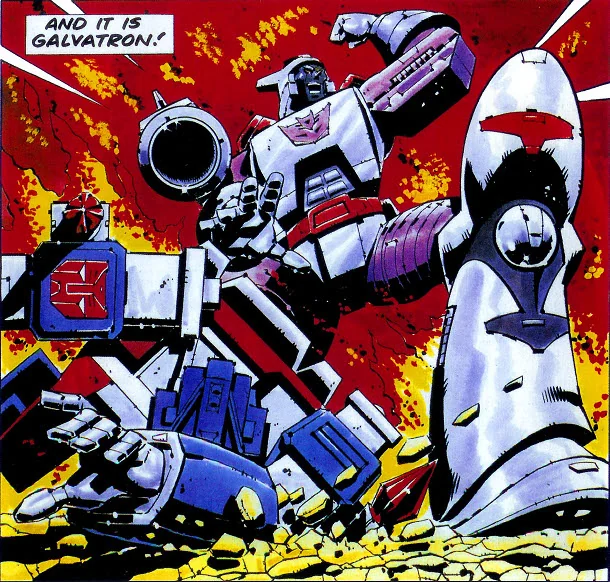
Marvel treats Galvatron as a distinct character rather than a continuation. Introduced through the Marvel UK 'Target: 2006' storyline, he travels back from 2006 to the present, temporarily disposes of Megatron, and thereafter operates as a free agent whose presence terrifies everyone including Shockwave, who arranges for the Dinobots to be aided against him in 'Fallen Angel' purely to protect his own position. In 'Enemy Action!' Galvatron tears through Shockwave's Seacons and island base while claiming to have come in peace, deliberately turning the Decepticons against him. Most tellingly, in 'Altered Image!' the brainwashed Megatron clone that Shockwave built specifically to kill Galvatron instead recognises a kindred spirit and joins him. The repeated time travel and the death of Cyclonus tear a rift in space-time that drives the 'Time Wars' arc. None of this maps onto the cartoon, where Galvatron simply is Megatron, remade.
Fate
In American cartoon continuity Galvatron survives season three and the finale 'The Rebirth' without a death scene, leaving him alive but with his story unresolved; Japanese continuity picks him up from there and carries him into the Headmasters series. In Marvel continuity his arc closes with the 'Time Wars' storyline, where the space-time rift created by his repeated journeys is sealed and the time-travellers are returned to their proper points in the timeline. Marvel UK's alternate future has him vanish after Unicron's 2006 attack on Cybertron, an absence that lets Shockwave seize Decepticon leadership.
Trivia
- Leonard Nimoy voiced Galvatron in The Transformers: The Movie, but Frank Welker had already recorded the season three arc 'Five Faces of Darkness' before Nimoy was cast, which is why the voice and the personality change so abruptly between film and series.
- The in-universe explanation offered for that shift is brain damage sustained in Galvatron's defeat at the end of the movie, applied retroactively.
- 'Webworld' was co-written by Len Wein, co-creator of Wolverine, which accounts for its unusually psychological premise.
- In Marvel comics continuity Galvatron is not Megatron's future self in any usable sense: he is a time-traveller from 2006 who arrives in the 1980s and meets, fights and eventually allies with a Megatron clone, so the two exist simultaneously.
- The 1986 movie never states plainly that Galvatron is Megatron; the connection is delivered almost entirely through Unicron's dialogue and Galvatron's own behaviour.
Contested
Where the cartoon, the Marvel comics and the toy bios disagree, or where a popular claim does not hold up. We record these rather than smoothing them over.
- Whether Galvatron is Megatron or a new individual wearing his memories is deliberately never settled in the cartoon, and the Marvel comics answer it the other way by having both exist at once.
- The cause of his madness varies by continuity: Unicron's reformatting, brain damage from the movie's finale, or simply Unicron's lingering control, all of which are asserted somewhere.
- His raw power level is wildly inconsistent, ranging from near-invincible to routinely beaten, and fandom argues over which portrayal is definitive.
- The Nimoy and Welker performances are different enough that fans treat movie Galvatron and series Galvatron as effectively separate characterisations.
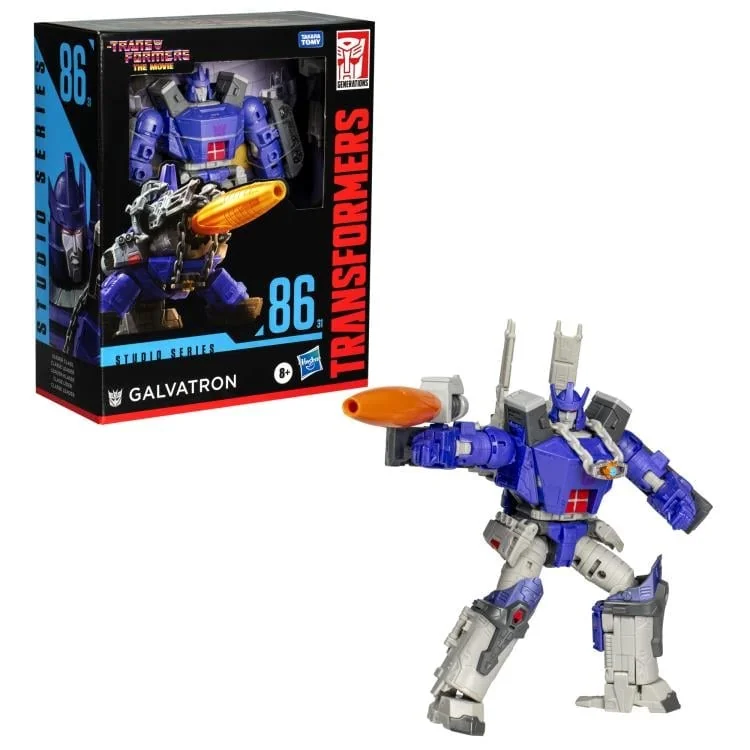
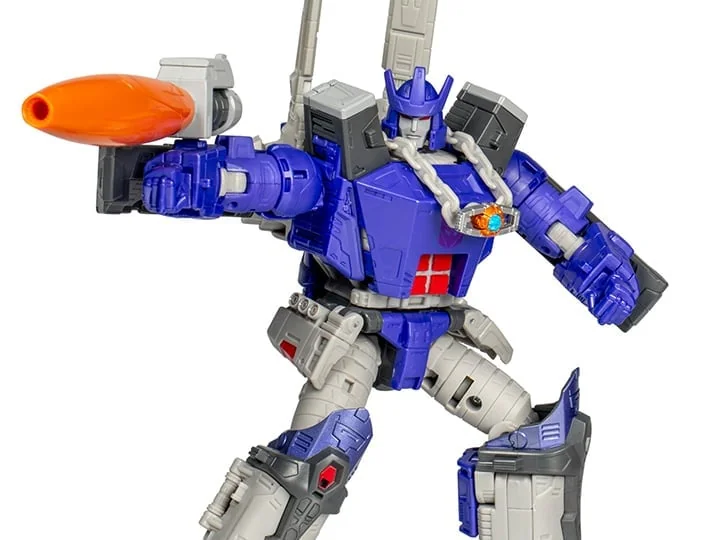
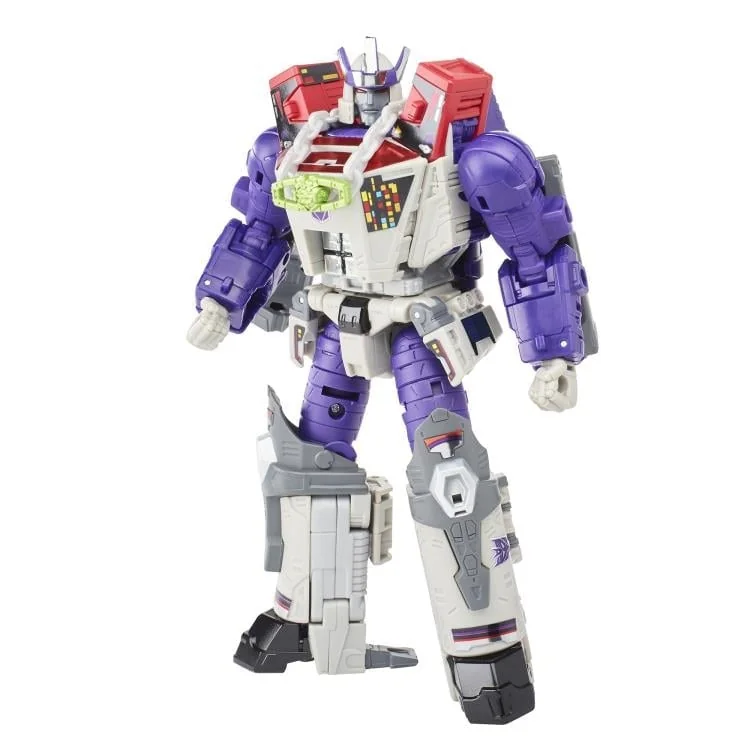
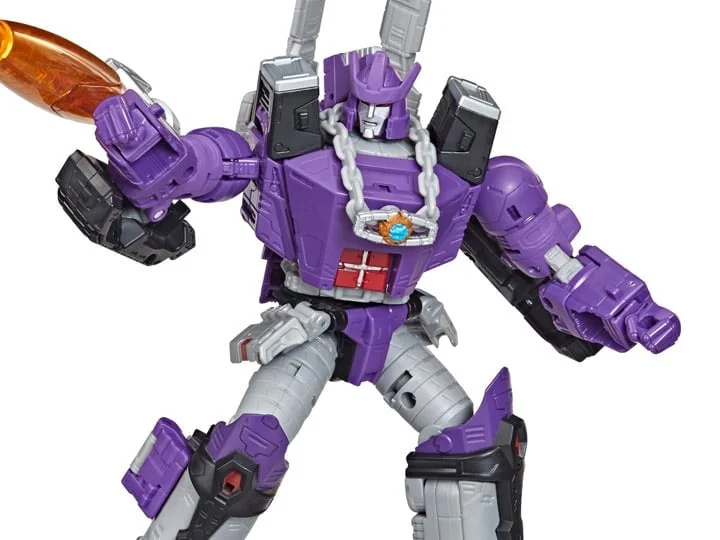
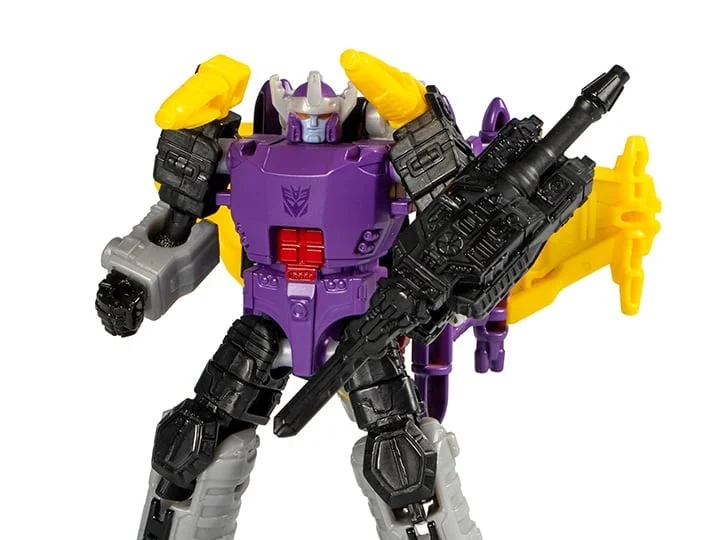
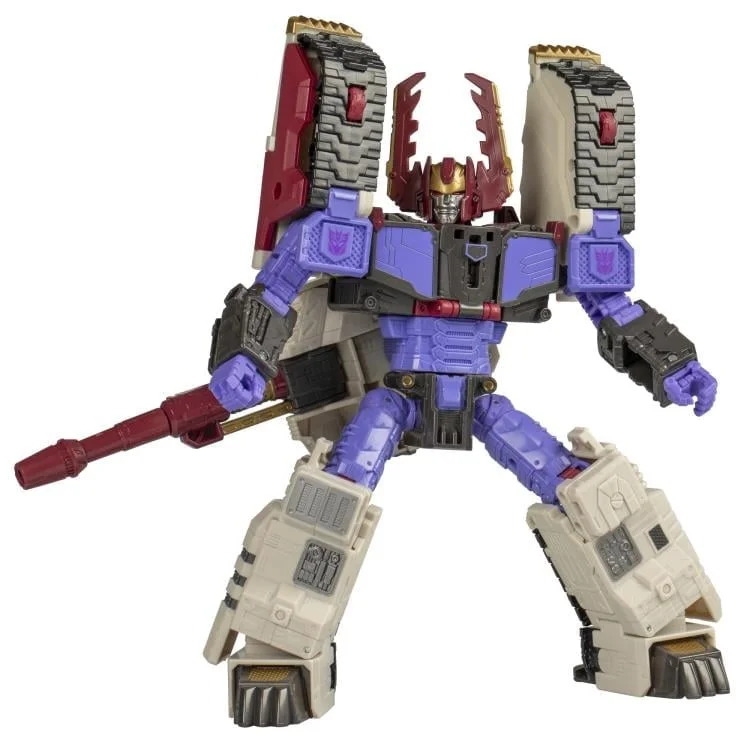
Galvatron figures
Some links are affiliate links. We may earn a commission at no extra cost to you.