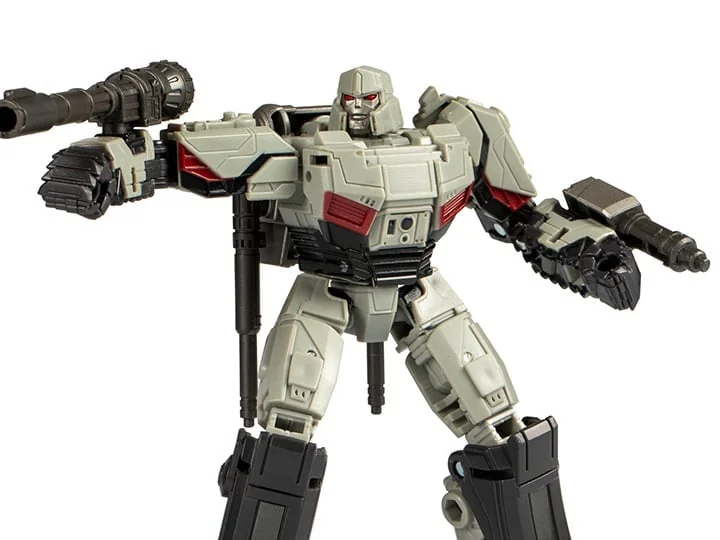
Decepticon
Megatron
Decepticon Leader
"Peace through tyranny."
A brilliant, physically overwhelming conqueror whose arrogance and taste for grand gestures repeatedly hand victory back to his enemies.
FactionDecepticon
Alt-modeWalther P38 pistol
Debut1984.09.17 . S01E01
VoiceFrank Welker
WeaponsFusion cannon . Energy mace
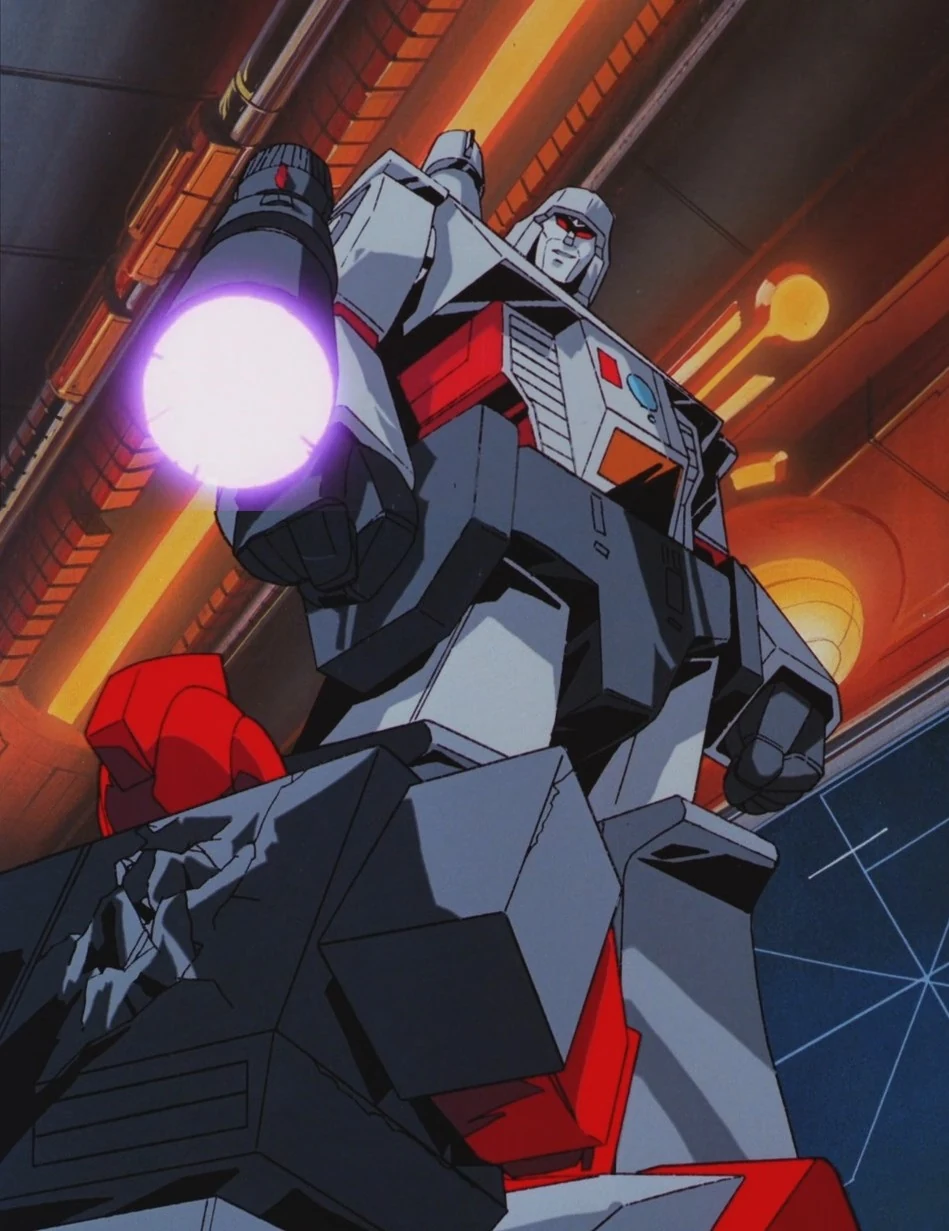
transformers.tv archive (curated)
Profile
Megatron is the Decepticon leader and the engine of the entire G1 conflict: a warlord whose stated goal is limitless energy and whose actual appetite is for dominion. In the cartoon he is introduced in "More Than Meets the Eye, Part 1" as the first Transformer revived by Teletraan I after four million years in the Ark, and within two episodes he has beaten Optimus Prime at the top of Sherman Dam and walked off with a power station's output. That pattern defines him. He does not skulk. He arrives, announces the plan, and dares anyone to stop him.
What separates him from a generic tyrant is his intelligence and his impatience with it. He builds the space bridge with Shockwave, engineers the Constructicons and Devastator, drains a prehistoric island in the "Dinobot Island" two-parter, and in "The Key to Vector Sigma" reaches back to Cybertron's creation engine to manufacture the Stunticons. He also cannot resist theatre, and it costs him. In "Heavy Metal War" he siphons the special abilities of his own troops into himself to beat Prime in single combat, wins, and is then swarmed the moment the cheat is exposed. In "Megatron's Master Plan" he actually succeeds, discrediting the Autobots and getting them exiled from Earth, and then squanders it.
His hierarchy is held by force and by the useful friction beneath him: Starscream constantly circling, Soundwave reporting the circling, Shockwave holding Cybertron. Megatron tolerates Starscream's treason for years, which is either supreme confidence or a failure of nerve depending on the episode. Frank Welker's performance, imperious and faintly amused, is a large part of why he still reads as the definitive villain of the franchise.
Abilities and weaknesses
Enormously strong in melee and durable enough to trade blows with Optimus Prime; his signature armament is the arm-mounted fusion cannon, capable of levelling structures, and he transforms into a particle-beam pistol that another Decepticon can fire, a mode that makes him one of the most destructive single weapons on either side. He is a capable engineer and strategist, personally responsible for the space bridge, the Constructicons and the Stunticons. Documented weaknesses: he burns fuel and energon at a punishing rate, his gun mode leaves him dependent on whoever is holding the trigger (Starscream, and in several episodes humans), and his overconfidence is treated in-fiction as a structural flaw rather than a quirk. His command style also creates the very instability that undermines him.
Tech specs
Strength
10/10
Intelligence
10/10
Speed
4/10
Endurance
8/10
Rank
10/10
Courage
9/10
Firepower
10/10
Skill
9/10
Key appearances
| Episode | Why it matters |
|---|---|
| More Than Meets the Eye, Part 2 | The Sherman Dam duel with Optimus Prime, the fight that establishes Megatron as Prime's physical equal. |
| Heavy Metal War | He absorbs every Decepticon's special ability to beat Prime one-on-one, then loses everything when the cheat is exposed. |
| The Ultimate Doom, Part 1 | His most ambitious scheme: dragging Cybertron itself into Earth orbit to harvest the resulting catastrophe. |
| Megatron's Master Plan, Part 2 | The rare episode where he wins, framing the Autobots and briefly conquering Central City. |
| The Key to Vector Sigma, Part 1 | Megatron as creator, using Cybertron's ancient supercomputer to give life to the Stunticons. |
Relationships
- Optimus Prime: the defining rivalry, personal rather than merely ideological, settled only when Megatron mortally wounds him at the Battle of Autobot City and takes a fatal blow in return.
- Starscream: Megatron's air commander and permanent would-be assassin, tolerated, mocked and blasted across roughly eighty episodes without ever being executed, until Starscream finally jettisons him from Astrotrain.
- Soundwave: his one genuinely trusted officer, valued precisely because Soundwave reports Starscream's plotting rather than joining it.
- Shockwave: left as guardian of Cybertron for four million years and treated as a loyal remote asset in the cartoon, a relationship the Marvel comics invert completely.
Comics versus cartoon
The Marvel Megatron is markedly less secure and considerably more unhinged. He is deposed almost immediately: Shockwave takes the Ark, revives the Decepticons and beats Megatron in a straight fight in 'The Worse of Two Evils!', leaving Megatron to grudgingly serve him. He claws back to a forced joint leadership in 'Second Generation!' and to sole command in 'Command Performances!', but the arc ends with him paranoid and delusional after his video-game duel with Optimus Prime, blowing up the space bridge while standing on it in 'Gone But Not Forgotten!'. The Megatron who reappears afterwards is later established as a clone. Crucially, Marvel's Megatron never becomes Galvatron; Galvatron is a separate time-travelling entity from 2006 whom Megatron actually meets and fights. Marvel also colours his helmet black or blue throughout, and his UK appearances run in parallel with US stories in ways that required the clone retcon to reconcile.
Fate
In cartoon continuity Megatron is fatally damaged by Optimus Prime at the Battle of Autobot City in The Transformers: The Movie, jettisoned into space by Starscream from Astrotrain, and found by Unicron, who reformats him into Galvatron in exchange for the destruction of the Autobot Matrix of Leadership. Megatron as such ceases to exist at that point in the American series. In Marvel continuity he instead apparently destroys himself in the space bridge explosion in 'Gone But Not Forgotten!', with a clone accounting for later appearances, and versions of him persist into the Generation 2 comics.
Trivia
- The toy is Takara's Micro Change MC-12 Gun Robo, a scale replica Walther P38 with silencer, stock and scope, which is why Megatron's cartoon alt mode is a handgun a human can pick up. G1 never explains the mass discrepancy; the show simply leans into it, letting Starscream and even humans fire him.
- Bob Budiansky stated the name is a portmanteau of 'megaton' and 'electronic'. Hasbro initially rejected it because 'mega' suggested nuclear weapons, until Budiansky pointed out the character was the villain.
- Megatron's early animation model was built from concept art for an unproduced prototype rather than the finished toy, with a black head and a back-mounted barrel. The Marvel comic kept colouring his helmet black or blue for the entire run.
- Frank Welker voiced Megatron in G1 and later reprised him in Family Guy and Robot Chicken. He also voiced the rival Renegade leader Cy-Kill in Challenge of the GoBots.
- After the Autobot City duel in the 1986 movie, Megatron's animation model was drawn with energon leaking from his eyes and mouth, an unusually graphic touch for the series.
Contested
Where the cartoon, the Marvel comics and the toy bios disagree, or where a popular claim does not hold up. We record these rather than smoothing them over.
- Whether Galvatron retains Megatron's identity is deliberately ambiguous in the cartoon and outright contradicted in Marvel, where Megatron and Galvatron coexist as separate characters.
- The gladiator-of-Tarn origin widely associated with Megatron comes from later Marvel UK and IDW-era material, not from the 1984 to 1987 American cartoon.
- The mass-shifting question (a warrior larger than a human becoming a pistol a human can hold) is never addressed in G1 fiction and remains the most-argued inconsistency in his design.
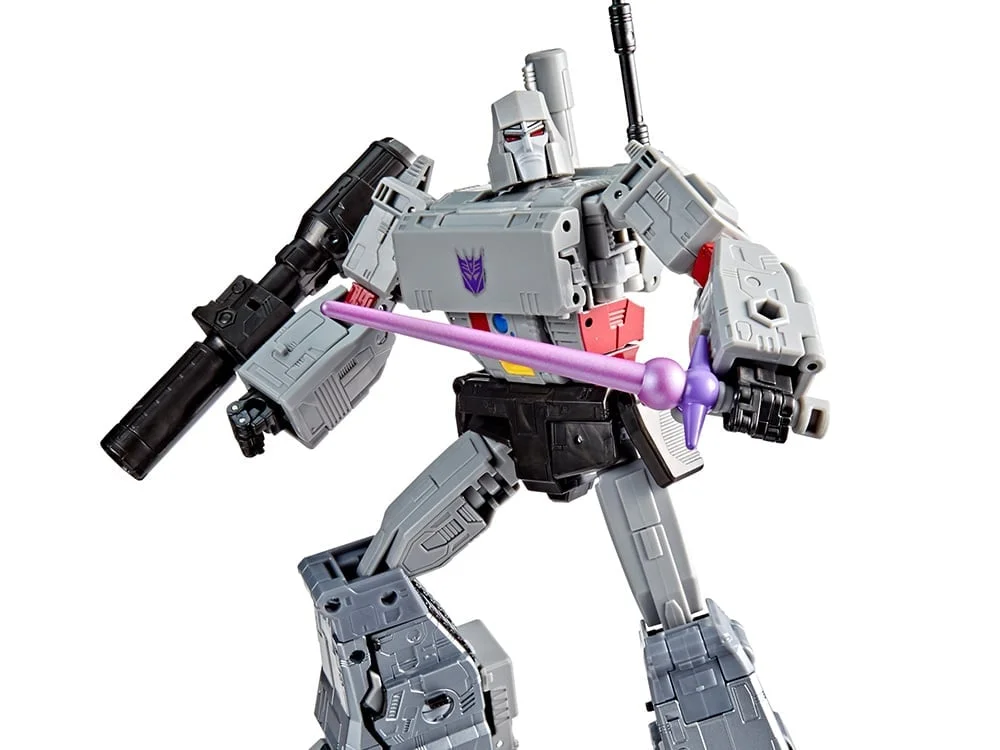
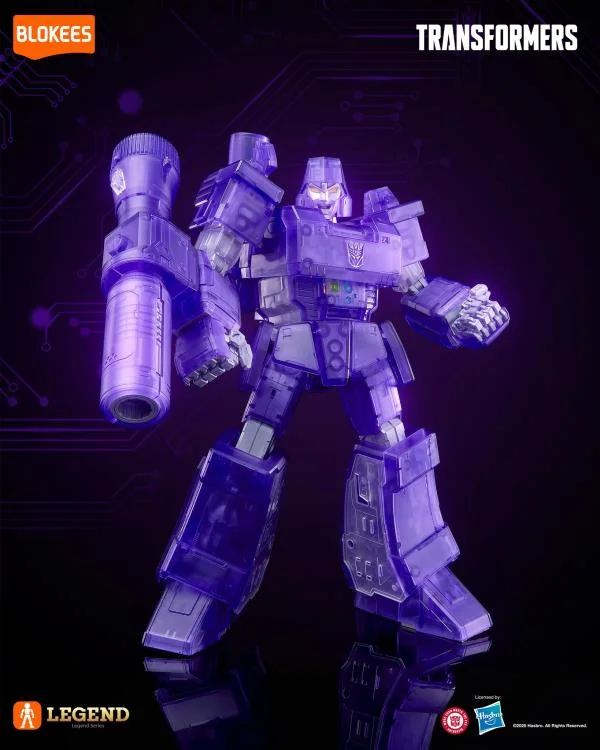
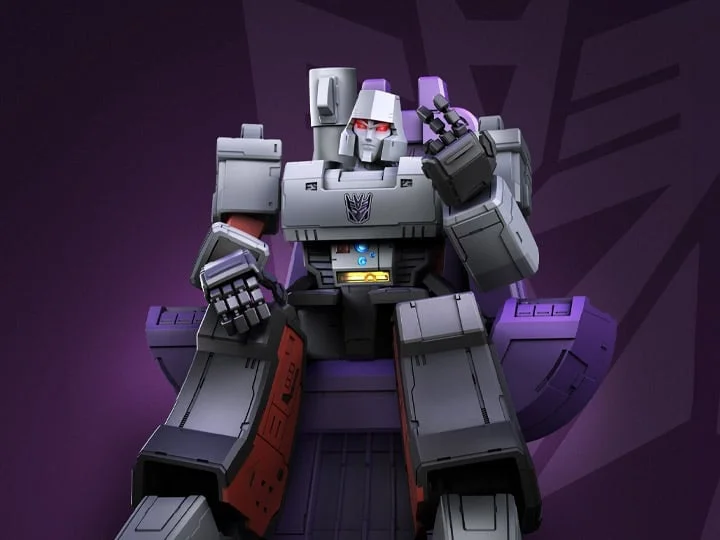
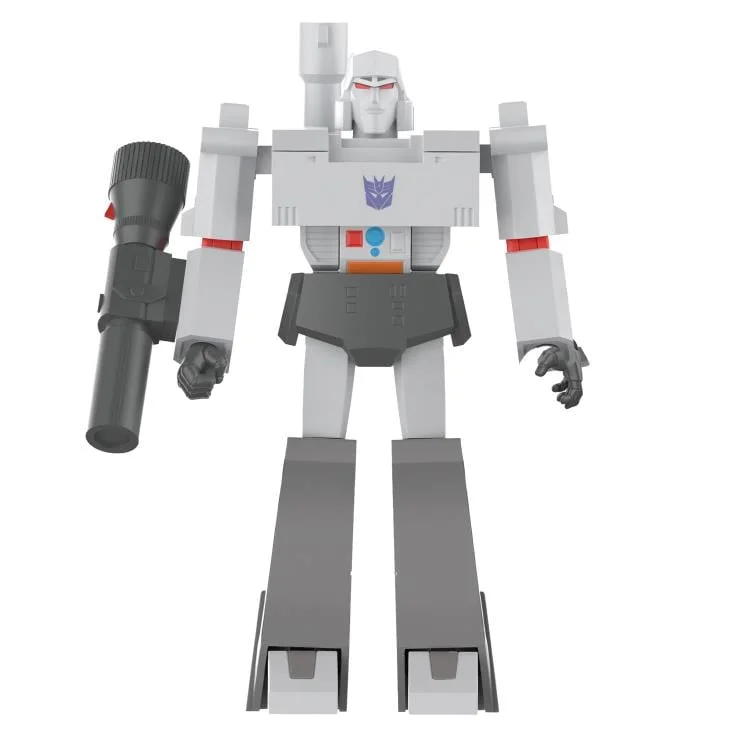
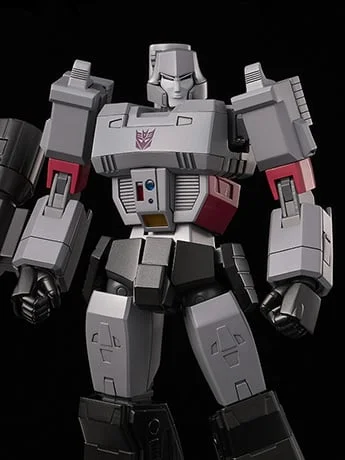
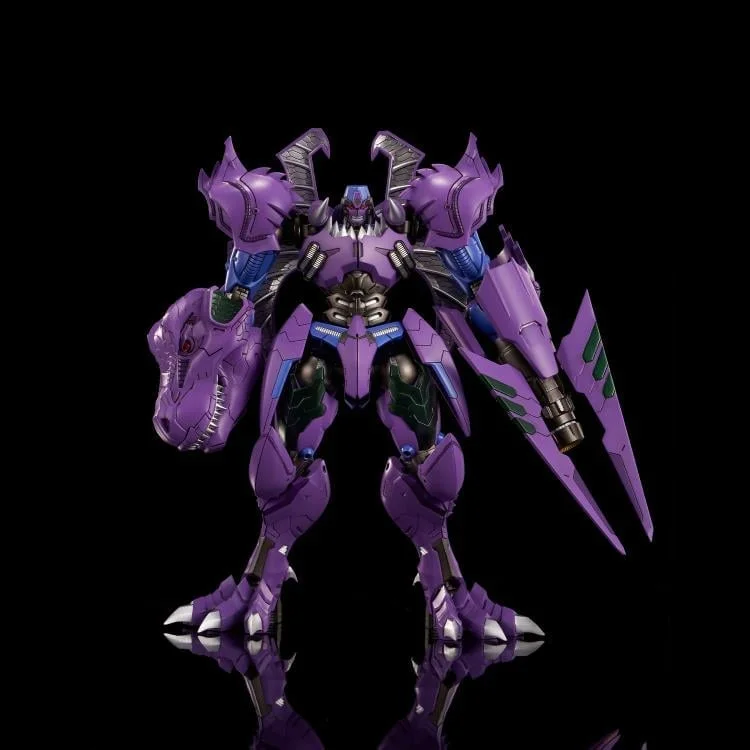
Megatron figures
Some links are affiliate links. We may earn a commission at no extra cost to you.